DUI vs. DWI: Key Differences & Insurance Impact in 2026
The difference between a DUI vs. DWI depends on how each state writes its impaired driving laws. Both lead to higher insurance costs. Drivers with clean records pay about $55 per month with Geico, but premiums can double after a DUI or DWI. Liberty Mutual charges the most after a DUI at $148 a month.
Read more Secured with SHA-256 Encryption





Table of Contents
Table of Contents

Insurance Content Creator
Lia Vergin develops both video and written content across all lines of insurance, with a primary focus on auto, home, and life coverage. She is dedicated to helping consumers better understand and navigate their insurance options. Driven by a passion for saving money and finding great deals, she is committed to creating clear, engaging, and practical content that empowers readers to make confident...
Lia Vergin

Managing Editor
Aleksandra J. Churlinov holds a Bachelor of Arts in English Language and Literature and a Master of Science in Marketing Management. Over the past six years, Aleks has focused on the insurance sector, working on a range of content, including business, auto, and life insurance. In April 2025, she stepped into the role of Managing Editor, where she now leads a team of talented insurance writers. ...
Aleksandra J. Churlinov

Commercial Lines Coverage Specialist
Michael Vereecke is the president of Customers First Insurance Group. He has been a licensed insurance agent for over 13 years. He also carries a Commercial Lines Coverage Specialist (CLCS) Designation, providing him the expertise to spot holes in businesses’ coverage. Since 2009, he has worked with many insurance providers, giving him unique insight into the insurance market, differences in ...
Michael Vereecke
Updated March 2026
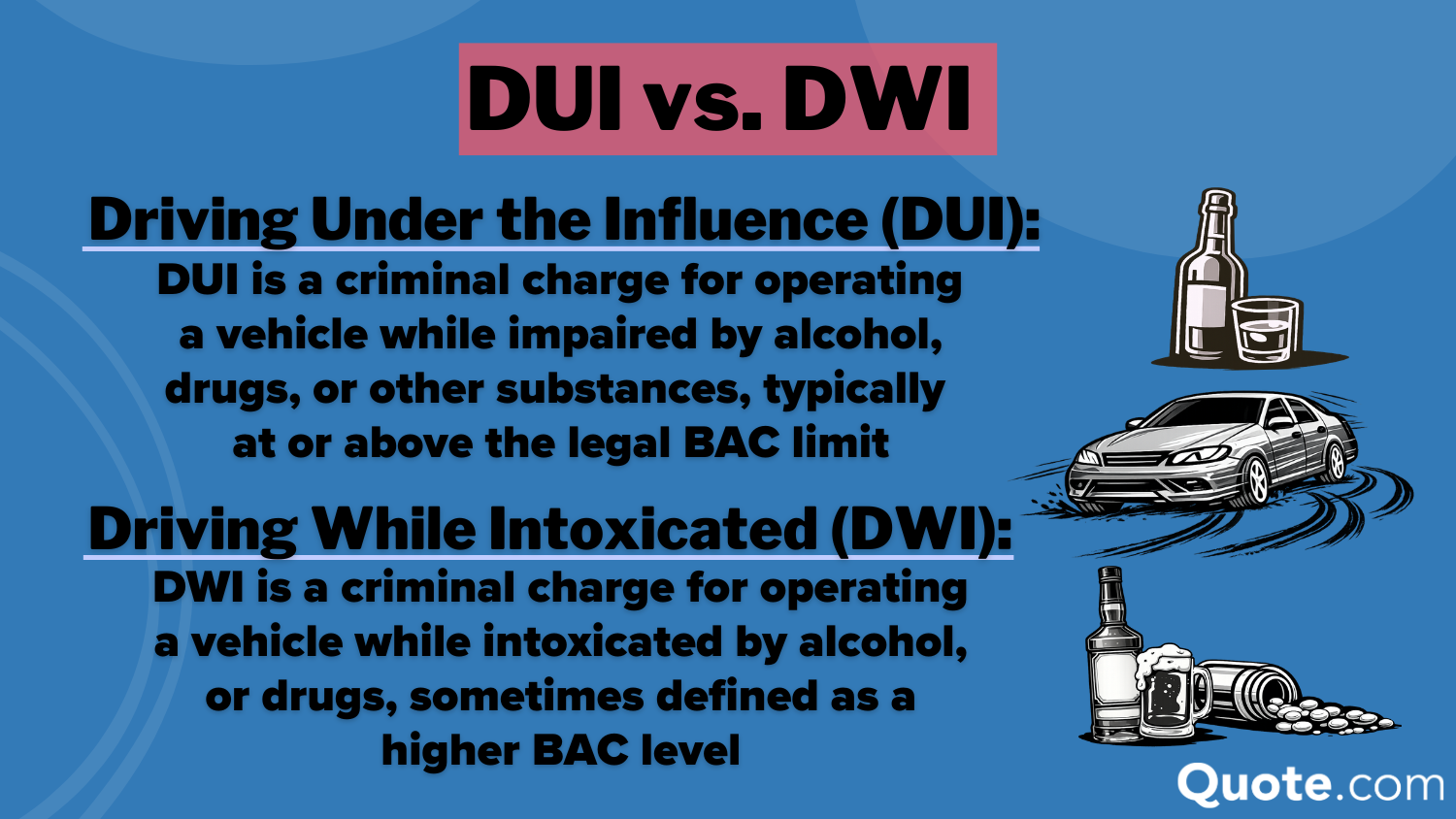
DUI vs. DWI both refer to impaired driving, but the exact charge depends on how each state defines the law and blood alcohol content (BAC) limits.
- DUI & DWI both mean impaired driving, but states define them differently
- A DUI can raise insurance from about $55 to roughly $148 per month
- Many states require SR-22 and license suspension after a DUI or DWI
Getting convicted can lead to serious consequences, including higher insurance costs, license suspension, fines, and possible jail time. Insurance companies treat these offenses as high risk, raising monthly rates from about $55 to nearly $150.
Many drivers look for cheap auto insurance for high-risk drivers to lower costs. Knowing DUI and DWI laws and SR-22 rules helps you understand what happens next.
Get the best auto insurance rates possible after a DUI and DWI by entering your ZIP code into our free comparison tool today.
Legal Differences Between DUI vs. DWI
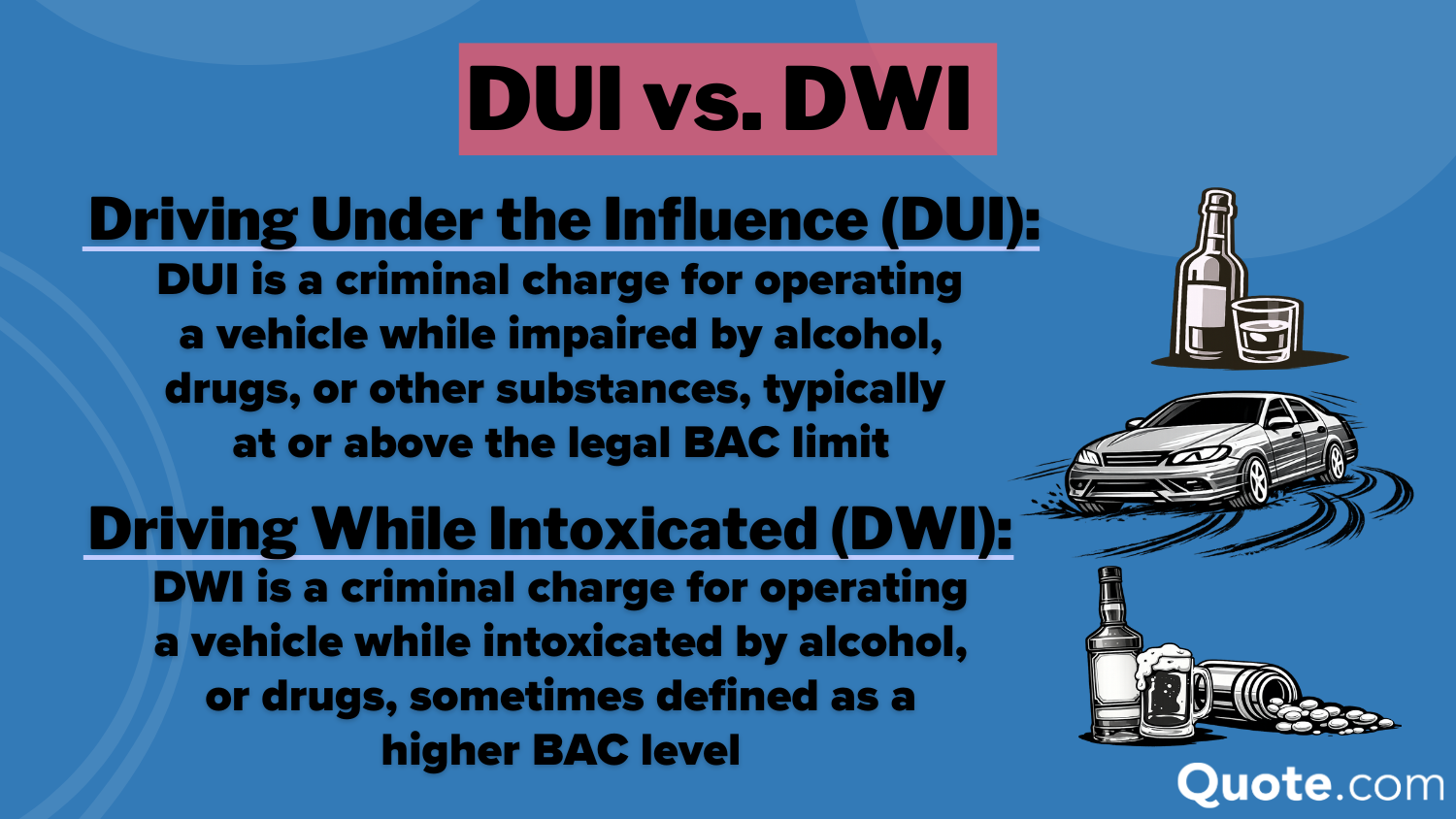
When you compare the DUI vs. DWI meaning, the difference comes down to how each state defines impaired driving.
A DUI usually applies when a driver shows clear impairment or reaches a blood alcohol concentration of .08% or higher.
DUI vs. DWI: Classification Differences| Category | DUI | DWI |
|---|---|---|
| BAC Threshold | Impairment or .08%+ | Often .08% or higher |
| Charge Severity | Usually standard tier | Sometimes elevated tier |
| Legal Term Usage | Common statutory term | Common statutory term |
| State Terminology | Primary term in 31 states | Primary term in 10 states |
| Under-21 Laws | Zero tolerance for minors | Zero tolerance for minors |
A DWI can apply at that same level, but in some states, it points to a more serious offense or a higher degree of impairment.
However, both DUI and DWI charges often carry similar legal weight when it comes to fines and penalties. Start searching for the cheapest auto insurance after a DUI to manage the higher costs.
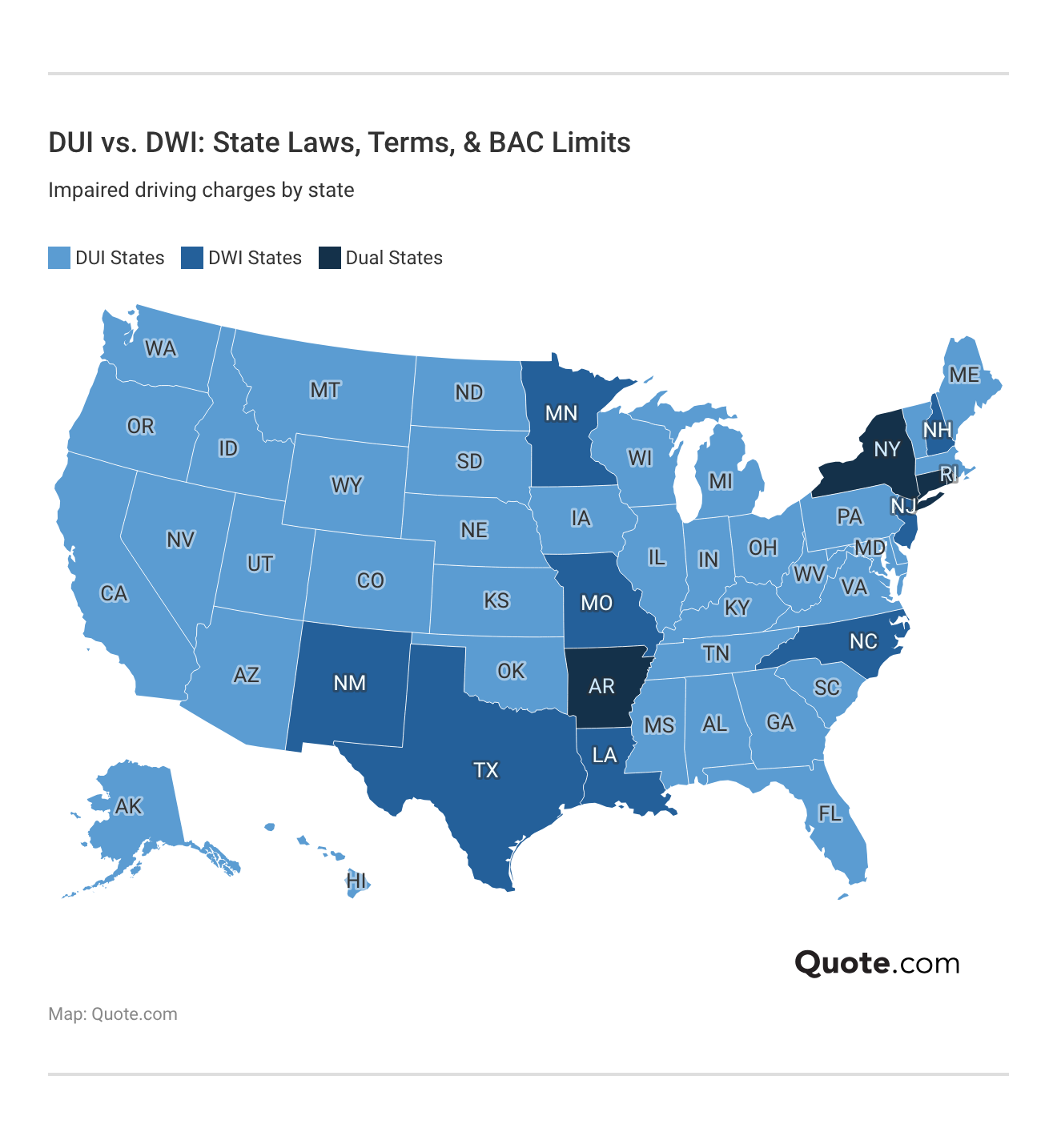
Our guide to auto insurance requirements by state shows that there isn’t one standard to follow. Some states use only DUI, others rely on DWI, and a few use both to separate lower and higher levels of impairment.
For drivers under 21, zero-tolerance laws apply in all states, so even a small amount of alcohol can lead to a charge.
DUI vs. DWI Penalties & Insurance Consequences
Many DUI versus DWI cases don’t involve just one charge. Drivers often face additional violations, such as reckless driving or causing an accident, depending on what happened during the stop.
Those added charges matter. An accident or reckless driving conviction can push insurance rates even higher than the DUI alone.
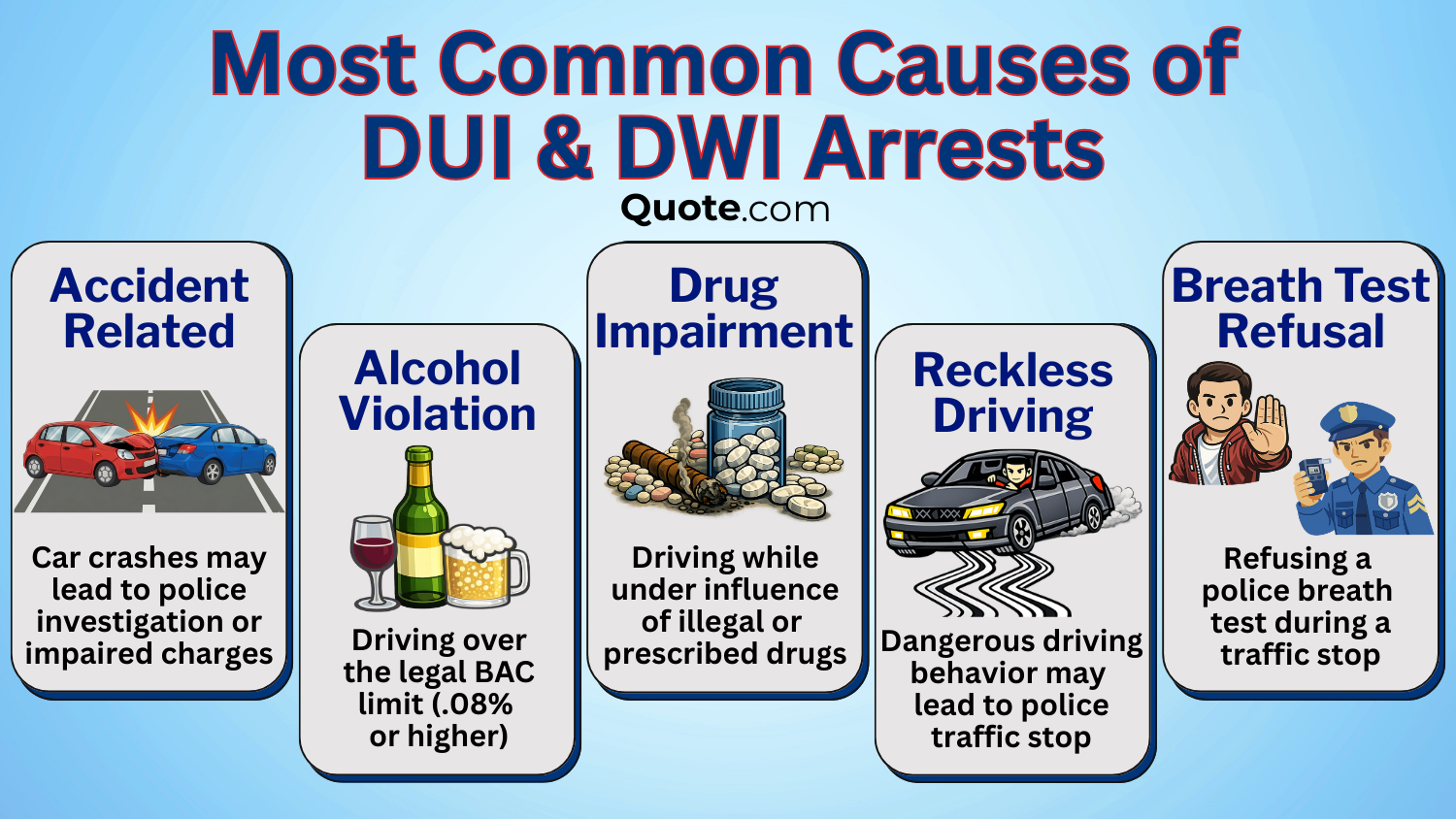
When a DUI or DWI leads to a crash or traffic violation, the legal and insurance impact becomes more serious. A higher BAC, an accident, or reckless driving signals a greater chance of future claims, which is why your premiums go up.
These are the most common DWI and DUI penalties, but state laws determine fine amounts, suspension periods, and additional penalties. Some extend suspensions, while others focus more on fines or required programs.
DUI vs. DWI Penalties by Offense| Charge | BAC | Fine | Jail Time | License Ban |
|---|---|---|---|---|
| 1st Offense | .08%+ | $2K | 6 months | 6-12 months |
| 2nd Offense | .08%+ | $4K | 1 year | 1-2 years |
| High BAC | .15%+ | $10K | 1 year | 1-2 years |
| Under 21 | .01%+ | $1K | 6 months | 6-12 months |
Penalties increase quickly for higher BAC levels or repeat offenders. A first offense often includes fines, possible jail time, and a temporary license suspension, but a second offense doubles fines and jail time.
Higher BAC readings lead to stricter penalties, and many states treat levels around .15% as a more serious offense.
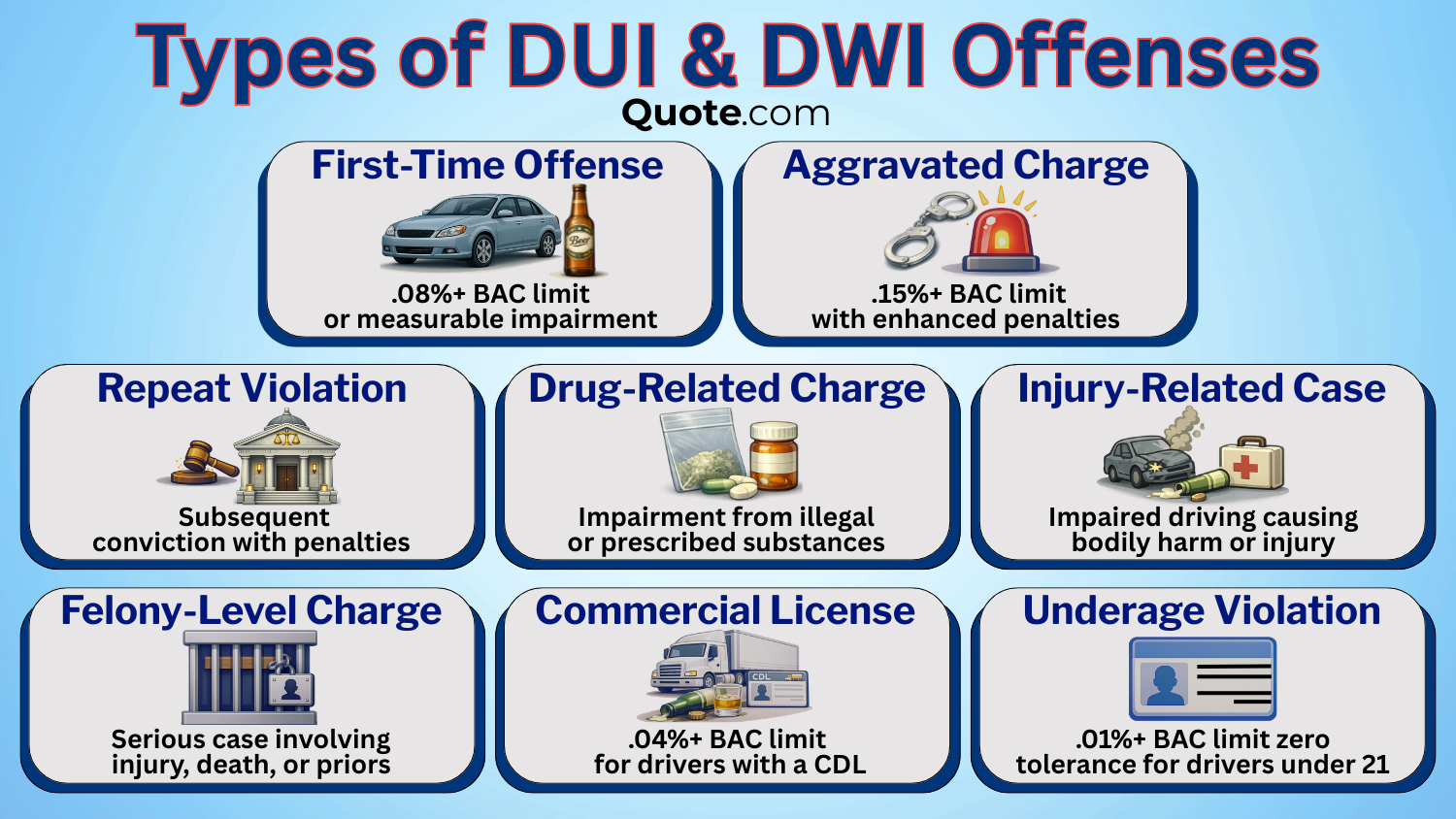
Different offense types, like repeat violations or felony charges, carry heavier consequences. Commercial drivers and underage drinkers also face additional penalties.
Working with an attorney can help you understand the details of your case and what affects both your record and your insurance policy.
Learn More: What Happens If You Cancel Auto Insurance
Free Auto Insurance Comparison
Compare Quotes From Top Companies and Save
Secured with SHA-256 Encryption
Comparing DUI and DWI Car Insurance Costs
A DUI or DWI will always push your premiums higher, no matter which company you choose.
Insurers flag these violations as high-risk behavior, so even the cheapest provider will charge more than they would for a clean record.
Clean Record vs. DUI vs. DWI Monthly Auto Insurance Rates| Company | Clean Record | After DUI | After DWI |
|---|---|---|---|
 | $78 | $133 | $140 |
 | $69 | $118 | $124 |
 | $56 | $96 | $101 |
 | $74 | $127 | $133 |
 | $55 | $94 | $99 |
 | $82 | $141 | $148 |
 | $64 | $110 | $116 |
 | $71 | $122 | $128 |
 | $59 | $100 | $105 |
 | $70 | $119 | $125 |
That said, the gap between companies can be significant. Geico is the only provider averaging under $100 a month after a DUI, compared to Liberty Mutual at $148 monthly.
That’s why shopping around becomes even more important after a conviction, because you could be overpaying with your current provider. Learn how to switch insurance providers in our guide.
After a DUI or DWI, start by confirming whether your state requires an SR-22 and compare quotes from several insurers.
Melanie Musson Published Insurance Expert
Comparing multiple quotes helps you find insurers that are more lenient with high-risk drivers or offer better pricing based on your situation.
You can start with these best insurance comparison sites to see how rates differ side-by-side. The goal isn’t to get back to your old rate right away but to avoid overpaying while your record recovers.
Timeline of DUI & DWI Impact on Insurance Premiums
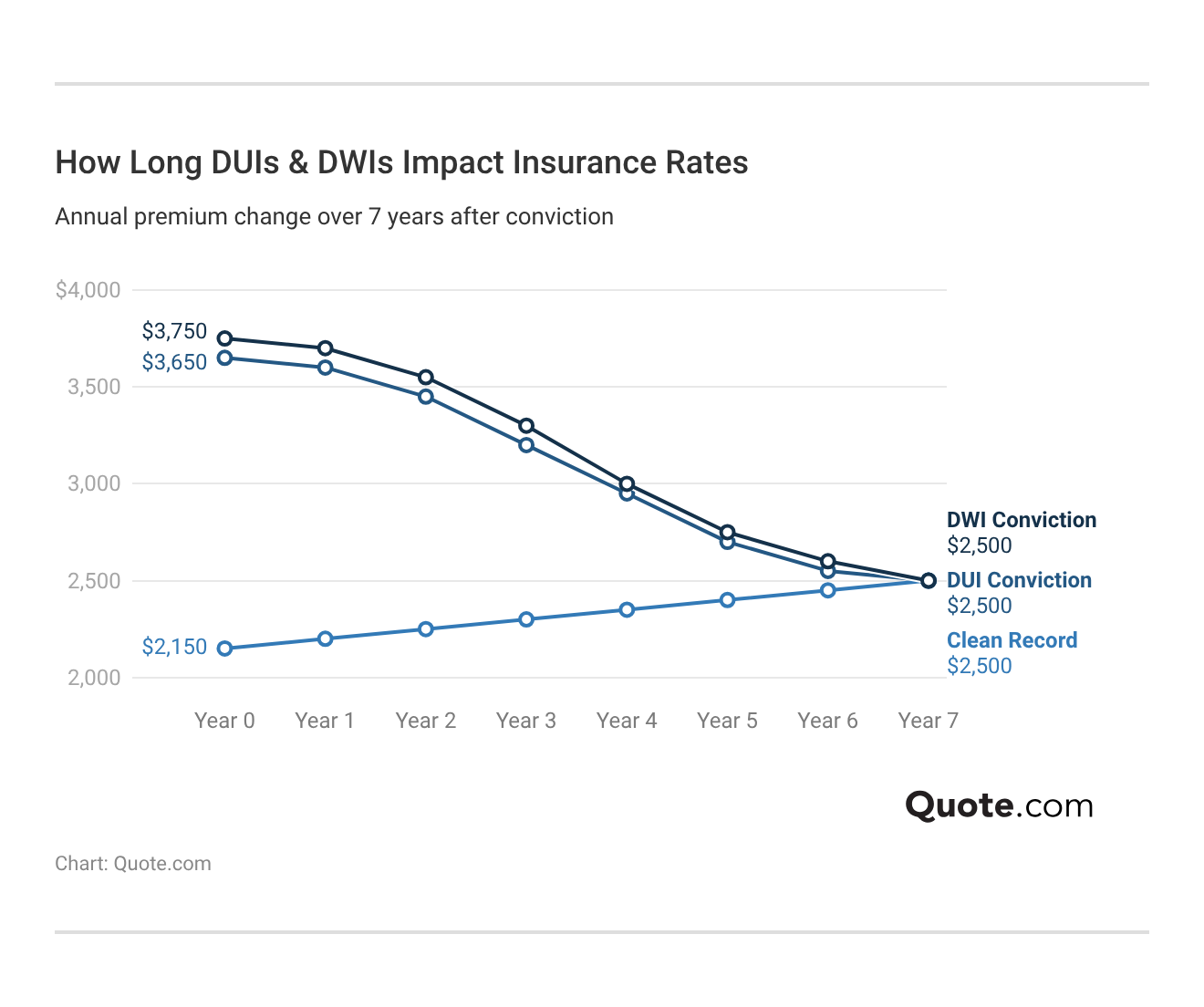
Your DUI or DWI violation carries the most weight in the first few years after the citation. It signals a higher chance of future claims, so companies price policies more aggressively.
As time passes without another incident, that assumption starts to fade. By the fourth or fifth year, rates start to ease because insurers no longer treat the DUI or DWI as a recent risk.
What makes the biggest difference during that time is what you do next. Avoiding new violations, tickets, or claims shows insurers that the DUI was a one-time mistake.
The biggest drops happen between years two and five, which is when insurers begin to reclassify you from “high risk” to something closer to average.
By year seven, the gap between drivers with a DUI or DWI and those with a clean record narrows because the violation has aged enough to matter less in pricing models.
That clean stretch is what brings your rates down faster than anything else. If you add another violation, the clock resets, and so do the higher premiums.
Check Out This Page: 26 Hacks to Save Money on Auto Insurance
How Driving Violations Affect Car Insurance Prices
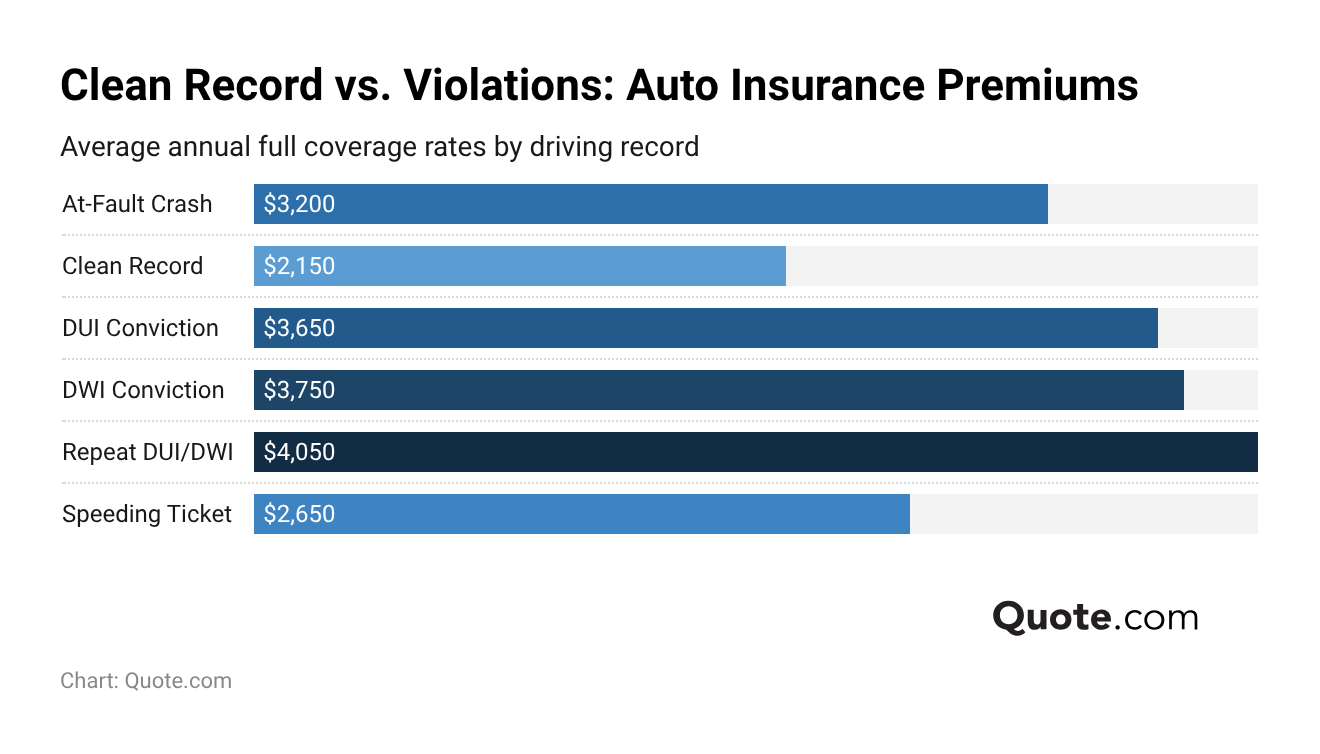
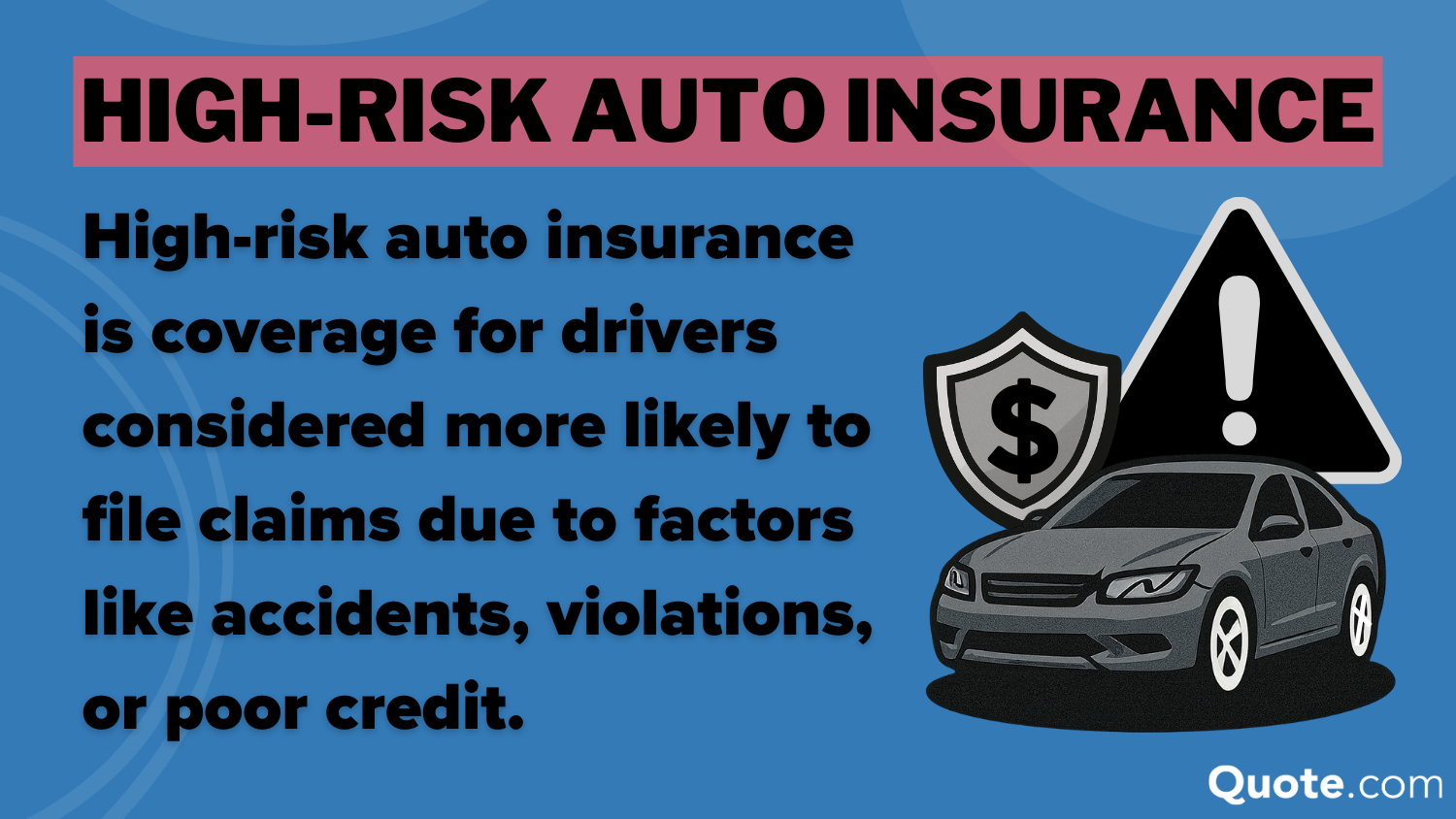
A clean driving record indicates a low-risk driver, but a single violation can quickly start to raise your rates.
Insurers now suspect that future claims will be more likely, prompting higher premiums. But not all violations carry the same weight.
Repeat offenses cost the most. Each new violation reinforces the same risk pattern, making insurers less willing to offer lower rates.
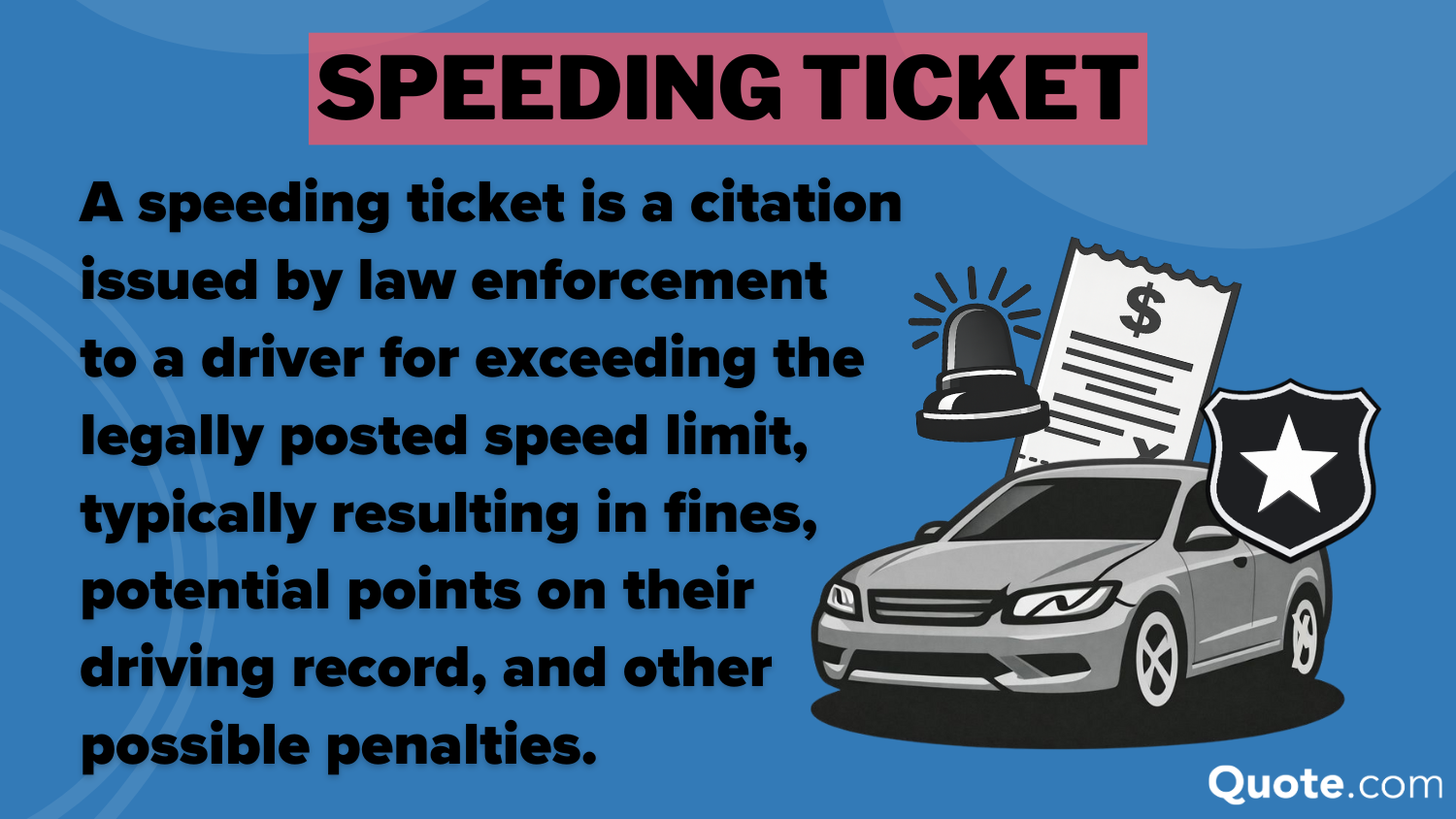
Speeding tickets affect auto insurance because they indicate risky behavior, but they don’t always indicate serious judgment problems. That’s why the increase is smaller than after DUIs or DWIs.
Alcohol-related violations trigger the largest rate hikes because they combine two risks at once: impaired judgment and a higher likelihood of costly accidents.
DWI and DUI cases often involve larger claims, legal complications, and a greater chance of repeat incidents. Over time, avoiding new incidents is what helps shift that risk profile back in your favor.
State DUI vs. DWI Laws & BAC Limits Explained
There’s not one uniform system of impaired driving that every state follows. Some states refer to the offense as DUI, others call it DWI, and a handful apply both terms depending on the circumstance.
Each state applies its own rules based on BAC level and level of impairment. That’s why you see different auto insurance rates by state.
You can see this in places like DUI vs. DWI in New York, where both terms exist under a dual system, and DUI vs. DWI in Virginia, where the structure and penalties differ.
Commercial drivers face stricter limits, with BAC levels near .04%, which can affect commercial auto insurance costs. Drivers under 21 also fall under zero-tolerance laws, so any detectable alcohol can count as a DUI or DWI violation.
State DUI vs. DWI Legal Definitions
States organize DUI versus DWI laws in several ways, so the meaning of each charge depends on where you drive. Some states follow a dual-term system. DUI covers lower BAC impairment, while DWI applies to higher BAC levels.
Other states rely on a DUI-only structure. In those places, DUI covers all impaired driving cases. A smaller group uses DWI as the main charge instead. In some states, the terms are used interchangeably, so DUI and DWI refer to the same crime.
DUI vs. DWI: State Legal Structure Comparison| Framework | DUI Scope | DWI Scope |
|---|---|---|
| Dual-Term | Lower BAC tier | Higher BAC tier |
| DUI-Only | All impaired driving | Not used |
| DWI-Only | Not used | All impaired driving |
| Interchangeable | Same as DWI | Same as DUI |
| Severity-Based | Standard offense | Aggravated offense |
A different model orders offenses from bad to worse. DUI is a typical impaired driving charge, while DWI represents something more serious in those states.
These legal frameworks dictate how police charge drivers, how courts process cases, and how insurance companies examine driving records. Understanding how your state defines these terms helps you know the legal and insurance impact after an impaired driving arrest.
Read More: Best Auto Insurance for Good Drivers
SR-22 Requirements After a DUI or DWI
After a DUI or DWI conviction, many states require an SR-22 filing before you regain full driving privileges. An SR-22 is not insurance.
It is a certificate your insurance company files with the state to confirm you carry the required auto coverage. Most states require this filing for about three years, though some shorten the period to two years or even one year, such as Kansas.
SR-22 Filing Requirements After DUI or DWI by State| State | Required? | Time Period |
|---|---|---|
| Alabama | ✅ | 3 Years |
| Alaska | ❌ | None |
| Arizona | ✅ | 3 Years |
| Arkansas | ✅ | 2 Years |
| California | ✅ | 3 Years |
| Colorado | ✅ | 3 Years |
| Connecticut | ❌ | None |
| Delaware | ✅ | 2 Years |
| Florida | ✅ | 3 Years |
| Georgia | ✅ | 3 Years |
| Hawaii | ✅ | 3 Years |
| Idaho | ✅ | 3 Years |
| Illinois | ✅ | 3 Years |
| Indiana | ✅ | 3 Years |
| Iowa | ✅ | 2 Years |
| Kansas | ✅ | 1 Year |
| Kentucky | ✅ | 2 Years |
| Louisiana | ✅ | 3 Years |
| Maine | ❌ | None |
| Maryland | ✅ | 3 Years |
| Massachusetts | ❌ | None |
| Michigan | ✅ | 3 Years |
| Minnesota | ✅ | 3 Years |
| Mississippi | ✅ | 3 Years |
| Missouri | ✅ | 2 Years |
| Montana | ✅ | 3 Years |
| Nebraska | ✅ | 3 Years |
| Nevada | ✅ | 3 Years |
| New Hampshire | ❌ | None |
| New Jersey | ✅ | 3 Years |
| New Mexico | ✅ | 3 Years |
| New York | ✅ | 3 Years |
| North Carolina | ✅ | 3 Years |
| North Dakota | ❌ | None |
| Ohio | ✅ | 3 Years |
| Oklahoma | ✅ | 2 Years |
| Oregon | ✅ | 3 Years |
| Pennsylvania | ✅ | 3 Years |
| Rhode Island | ✅ | 3 Years |
| South Carolina | ✅ | 3 Years |
| South Dakota | ✅ | 3 Years |
| Tennessee | ✅ | 3 Years |
| Texas | ✅ | 2 Years |
| Utah | ✅ | 3 Years |
| Vermont | ✅ | 3 Years |
| Virginia | ✅ | 3 Years |
| Washington | ✅ | 3 Years |
| West Virginia | ✅ | 3 Years |
| Wisconsin | ✅ | 3 Years |
| Wyoming | ✅ | 3 Years |
A few states do not require SR-22 filings at all after a DUI or DWI, including Alaska, Connecticut, Maine, Massachusetts, New Hampshire, and North Dakota.
The requirement depends on state law and the severity of the offense. During the filing period, you must keep continuous insurance coverage.
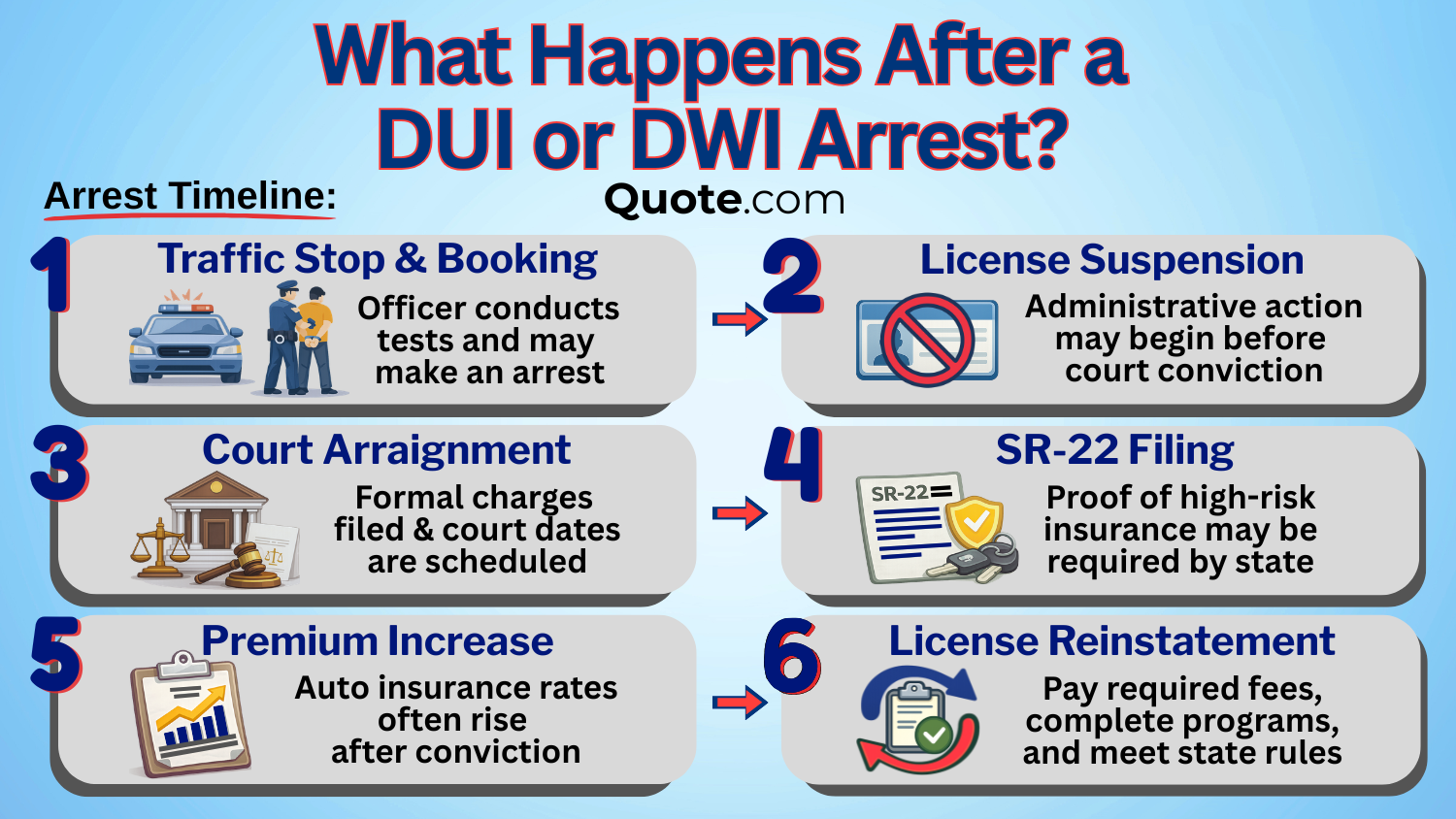
If your policy cancels or lapses, the insurer reports the change to the state, which often leads to another license suspension.
Checking your state’s SR-22 rules helps you understand how long the filing lasts and what steps you need to take to keep your license active, including when you may need SR-22 auto insurance to maintain legal driving privileges after a violation.
Free Auto Insurance Comparison
Compare Quotes From Top Companies and Save
Secured with SHA-256 Encryption
Find Affordable Insurance After a DUI or DWI
A DUI vs. DWI can lead to more than a traffic ticket. Depending on the state, drivers may face license suspension, fines, and a lasting mark on their driving record.
The insurance effects after a DUI or DWI start at your next renewal. Insurers adjust your policy for higher risk, resulting in a significant increase in monthly premiums. Compare rates from the best car insurance companies to save money after a violation.
Many drivers find their rates rising from around $55 a month to at least $100 after a conviction. Some states also require an SR-22 before you can legally get back behind the wheel, adding another layer of expense and responsibility.
Maintaining a clean driving record moving forward can make a real difference when you’re trying to save money.
If you have a DUI or DWI on your record, keep continuous insurance coverage because a lapse during the required SR-22 period can trigger another license suspension and extend how long you pay higher premiums.
Daniel Young Managing Editor
Keeping your policy active during that period matters. A lapse can trigger another suspension and extend how long you pay higher rates, making it harder to get back to more affordable coverage.
Taking the time to understand how DUI versus DWI laws work in your state helps you see the full legal and financial impact. Protect your vehicle at the best prices after a DUI and DWI by entering your ZIP code into our free auto insurance quote comparison tool.
Frequently Asked Questions
What is the difference between DUI and DWI?
A DUI and a DWI are both criminal charges for operating a vehicle while under the influence of drugs or alcohol. Most states use these terms interchangeably. In others, DWI (Driving While Impaired) can be defined with a higher BAC level. Offenses can carry fines, license suspension, and up to a year in jail.
Is DWI or DUI worse?
Whether a DWI or DUI is worse depends on state law. Some states treat the terms the same, while others use DWI for more serious impairment levels. In either case, both charges can lead to fines, license suspension, and higher insurance premiums. Use our free comparison tool to see how DUIs and DWIs affect rates in your area.
What’s the maximum penalty for a DUI?
Maximum DUI penalties depend on the state and the driver’s history. Repeat offenses often bring the biggest penalties, with large fines, long license suspensions, extended jail time, and even felony charges. This pattern is consistent with what we learned analyzing insurance companies and how they assess risk after serious violations.
What is the fine for driving under the influence for the first offense?
A first offense usually includes fines of around $1,000–$2,000. What is the most common penalty for a first-time DUI or DWI? You face possible jail time and license suspension for several months after your first DUI, depending on the state and BAC level.
What is the minimum jail time for a DUI?
Minimum jail time varies by state. Some states impose no mandatory jail time for a first offense, while others require a few days in jail or allow alternatives like probation or alcohol education programs.
What’s the difference between a DUI and a DWI in Texas?
In Texas, DWI usually applies to drivers with a blood alcohol concentration of 0.08% or higher, while DUI mainly applies to drivers under age 21 who have any detectable alcohol in their system. Get quotes in our guide to auto insurance companies in Texas to find more affordable coverage.
What is the punishment for a first DWI in Texas?
A first DWI in Texas can result in fines up to $2,000 and license suspension for up to one year. Texas drivers also face up to 180 days in jail, although many first-time cases result in probation rather than a full jail sentence.
Is DUI a felony in California?
Most DUI offenses in California are misdemeanors, but they can become felonies if the driver causes serious injury, has multiple prior DUI convictions, or was previously convicted of a DUI vs. DWI felony. Enter your ZIP code to see how a DUI changes rates in your state.
What happens if you get a DWI in North Carolina?
North Carolina uses a five-level sentencing system for DWI offenses, which may include fines, jail time, license suspension, and alcohol treatment programs. Penalties increase for repeat offenses, and auto insurance companies in North Carolina will review these violations when setting your premiums.
What is the penalty for first-time DWI in New York?
A first DWI in New York can include fines from $500 to $1,000, up to one year in jail, license suspension for at least six months, and mandatory alcohol education programs.
How are DUI vs. DWI laws defined in Arkansas?
How do DUI vs. DWI charges work in Maryland?
How does DUI vs. DWI work in Missouri for alcohol vs. drug impairment?
What is worse in New Jersey, DWI or DUI?
Related Articles




Get a FREE Quote in Minutes
Insurance rates change constantly — we help you stay ahead by making it easy to compare top options and save.
Secured with SHA-256 Encryption