Modified Endowment Contract (MEC): 2026 Tax Rules
A modified endowment contract (MEC) is a life insurance policy that loses tax benefits due to overfunding. Withdrawals are taxed differently and may face a 10% penalty before age 59½, but MECs can still be useful for estate planning and wealth transfer.
Read more




Table of Contents
Table of Contents

Head of Content
Meggan McCain, Head of Content, has been a professional writer and editor for over a decade. She leads the in-house content team at Quote.com. With three years dedicated to the insurance industry, Meggan combines her editorial expertise and passion for writing to help readers better understand complex insurance topics. As a content team manager, Meggan sets the tone for excellence by guiding co...
Meggan McCain

Senior Director of Content
Sara Routhier, Senior Director of Content, has professional experience as an educator, SEO specialist, and content marketer. She has over 10 years of experience in the insurance industry. As a researcher, data nerd, writer, and editor, she strives to curate educational, enlightening articles that provide you with the must-know facts and best-kept secrets within the overwhelming world of insurance....
Sara Routhier

Commercial Lines Coverage Specialist
Michael Vereecke is the president of Customers First Insurance Group. He has been a licensed insurance agent for over 13 years. He also carries a Commercial Lines Coverage Specialist (CLCS) Designation, providing him the expertise to spot holes in businesses’ coverage. Since 2009, he has worked with many insurance providers, giving him unique insight into the insurance market, differences in ...
Michael Vereecke
Updated June 2026
A modified endowment contract (MEC) is a life insurance policy that fails the IRS’s 7-pay test, resulting in different tax treatment compared to standard life insurance.
- MECs are overfunded life insurance policies that lose tax-free loan access
- Withdrawals before age 59½ may be taxed and include a 10% penalty
- Death benefits remain tax-free for beneficiaries under MEC rules
While a typical life insurance policy allows for tax-free access to cash value and death benefits, a MEC is treated more like a taxable investment.
Understanding MEC classification is important for anyone using life insurance as a wealth-building or estate planning tool, especially if you’re contributing large sums to the policy early on. Enter your ZIP code to compare life insurance quotes and find policies that fit your goals.
What is a Modified Endowment Contract?
Readers often ask, “What is a MEC?” The modified endowment contract definition refers to a type of permanent life insurance policy funded beyond federal tax limits. When that happens, the IRS changes how the policy is taxed.
MEC rules are designed to prevent individuals from using life insurance primarily as a tax-advantaged investment vehicle rather than for protection.
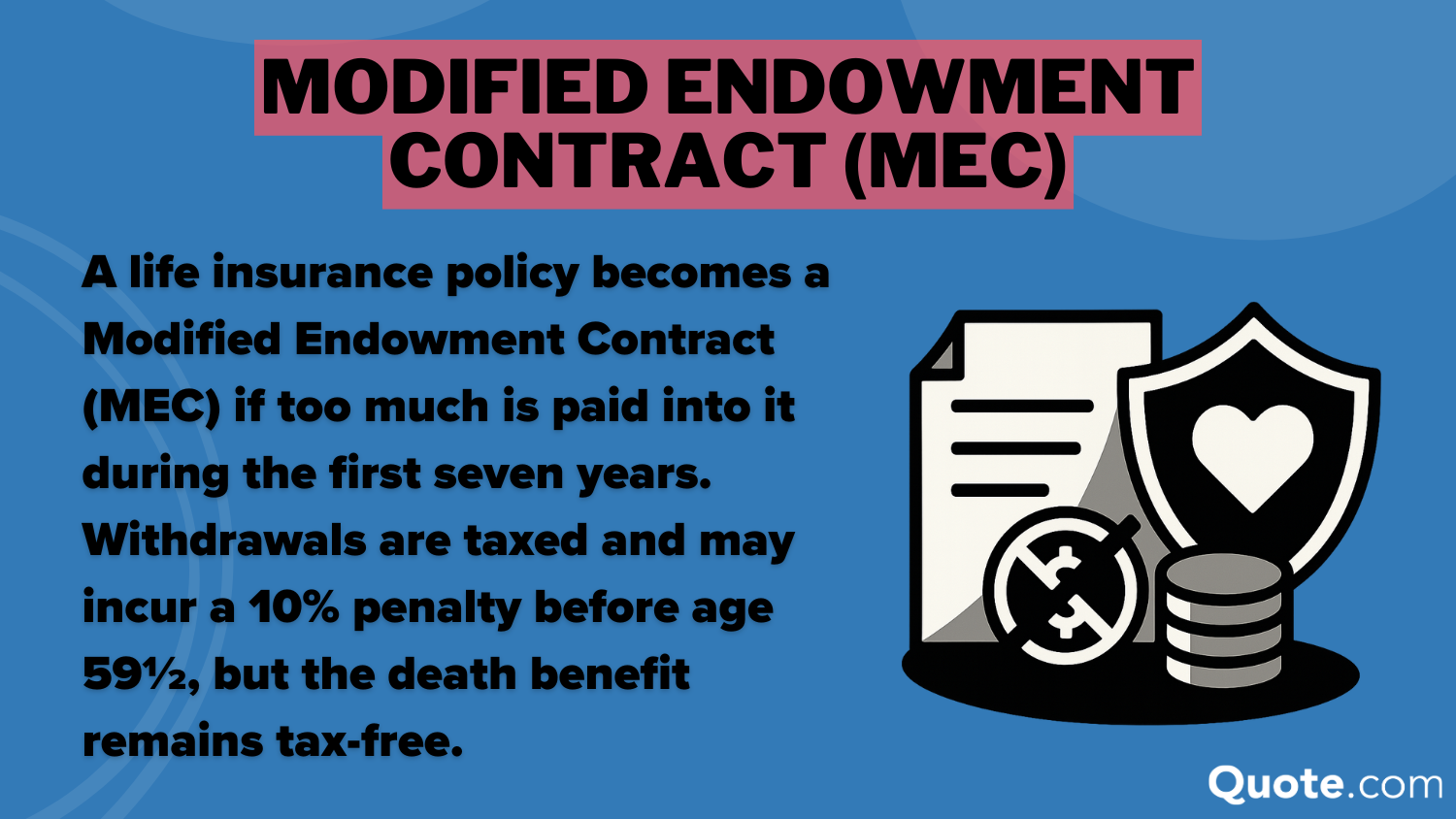
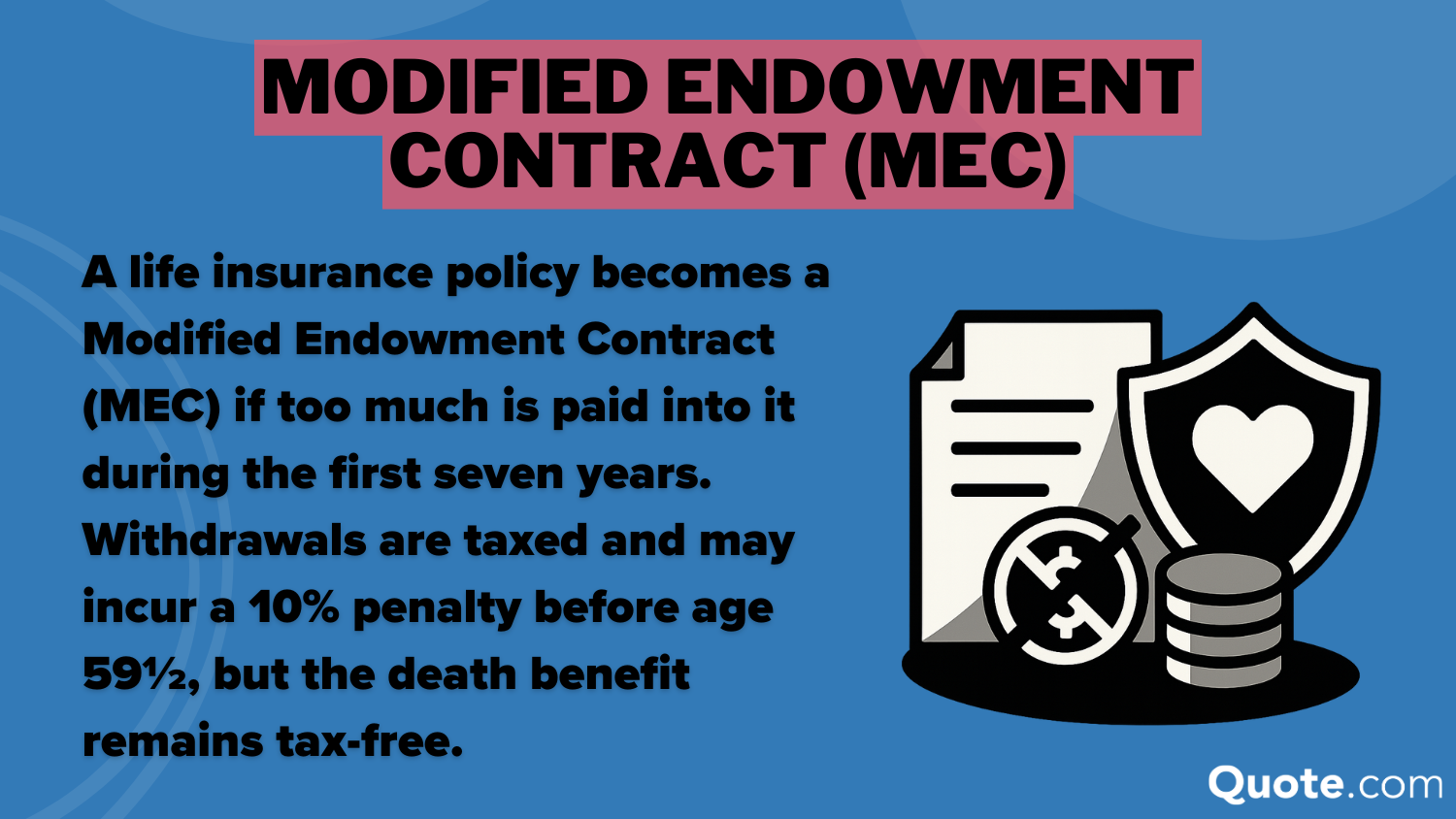
It still pays a tax-free death benefit, but loans and withdrawals are taxed as income and may be subject to a 10% modified endowment contract penalty before age 59½.
Distributions from a MEC follow “last-in, first-out” (LIFO) tax treatment, meaning earnings are withdrawn before principal and are taxed first.
MEC vs. Non-MEC Policies Compared| Feature | MEC Policy | Non-MEC Policy |
|---|---|---|
| 10% Penalty (<59½) | Yes | No |
| Cash Value Access | Restricted | Flexible |
| Death Benefit | Tax-free | Tax-free |
| Loans | Taxable | Tax-free |
| Withdrawal Taxation | LIFO (gains first) | FIFO (basis first) |
Once classified as an MEC policy, the status is permanent and cannot be reversed, even if future premiums are reduced. This classification also carries over through a 1035 exchange, meaning a MEC remains a MEC even if it’s transferred into a new life insurance policy.
In a standard life insurance policy, you can usually access cash value with better tax treatment. However, pre-death distributions from a modified endowment contract are taxed less favorably due to LIFO rules, meaning gains are withdrawn first and taxed as income.
Free Life Insurance Comparison
Compare Quotes From Top Companies and Save
Why a Life Insurance Policy Turns Into a MEC
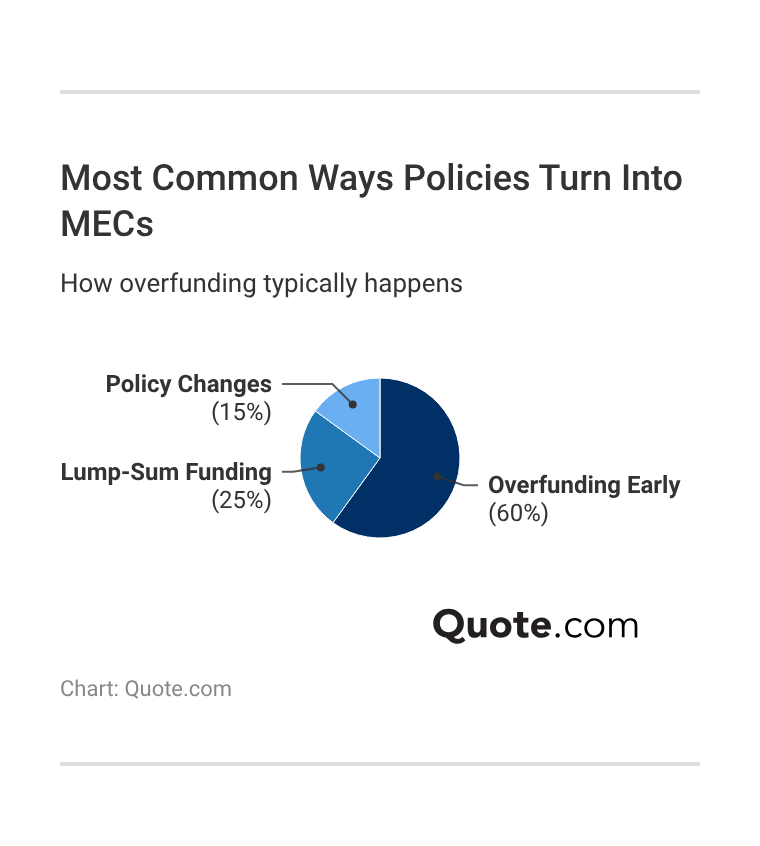
A life insurance policy becomes a modified endowment contract when it’s funded too quickly, meaning total premiums paid exceed IRS limits within a set period.
These limits help ensure life insurance is used for protection, not as a tax-advantaged investment.
Many people create a MEC without realizing it by overfunding early. Once that happens, the tax treatment changes permanently.
Michelle Robbins Licensed Insurance Agent
The IRS uses the modified endowment contract 7-pay test to determine whether a policy has been overfunded.
It compares the premiums you pay to the maximum allowed amount, based on seven equal annual payments.
If you exceed that modified endowment contract insurance limit at any point, the policy fails the test and is automatically classified as a MEC. This status is permanent and can’t be reversed, and no election or paperwork is required.
Example
If your policy is structured for $5,000 per year over seven years and you pay $10,000 in one year, you exceed the limit.
👉 Result: That excess payment causes the policy to fail the 7-pay test and become a MEC.
How to Avoid a Modified Endowment Contract
To keep your life insurance policy’s tax benefits, pay close attention to how you fund it. Staying within modified endowment contract IRS limits helps you avoid MEC status.
- Keep premiums within the 7-pay test limits at all times.
- Avoid large lump-sum payments that can trigger a MEC.
- Watch for policy updates that may restart the 7-pay test.
- Work with your insurer to help monitor premium limits.
Regularly reviewing your policy’s funding schedule helps ensure small premium changes don’t push the policy over IRS limits. Policy changes, such as benefit increases or adding riders, can reset IRS testing periods, so ongoing monitoring matters.
With the right approach, you can maintain tax-free access to your policy’s cash value.
Modified Endowment Contract Tax Consequences
Once a policy is classified as a MEC in life insurance, the main difference is how withdrawals and loans are taxed. The death benefit generally stays income tax-free, but access to the cash value becomes less favorable.
- Early Withdrawals May Be Penalized: Early modified endowment contract withdrawals may face a 10% IRS penalty if taken before age 59½, on top of income taxes.
- Policy Loans Are Taxable: Loans are treated as taxable distributions rather than tax-free access to cash value.
- Withdrawals Are Taxed First: Policy loans are taxable and treated as distributions.
By comparison, non-MEC life insurance policies usually let you withdraw your original premiums first and take policy loans without triggering taxes. That makes MEC status an important factor if you plan to use your policy’s cash value.
Free Life Insurance Comparison
Compare Quotes From Top Companies and Save
Types of Life Insurance That Can Become MECs
Permanent life insurance policies, which build cash value, can become modified endowment contracts if they’re overfunded. These include:
- Indexed Universal Life (IUL) Insurance
- Universal Life Insurance
- Variable Life Insurance
- Whole Life Insurance
IUL policies are especially prone to becoming MECs when policyholders overfund them early to maximize tax-advantaged growth tied to market index performance.
Any permanent policy with cash value is subject to the 7-pay test and can be classified as a MEC if it’s funded too aggressively over a short period. For example, a variable life MEC occurs when a variable life insurance policy exceeds funding limits and loses its standard tax advantages.
Term life insurance doesn’t build cash value, so it can’t become a MEC.
Single Premium Life Insurance and MEC Status
Single premium life insurance is usually built like a MEC from day one.
Since the policy is funded with one large upfront payment, it often exceeds the IRS 7-pay test limits and gets classified as a MEC right away.

That doesn’t make it bad. Single premium life insurance can still offer lifetime coverage, cash value growth, and a tax-free death benefit.
The trade-off is access: withdrawals and loans may be taxable under MEC rules, so these policies are usually better for estate planning, wealth transfer, or legacy goals than flexible cash access.
MEC vs. Traditional Life Insurance Policies
While both types offer death benefit protection, modified endowment contracts (MECs) are more rigid and tax-heavy if you plan to access funds during your lifetime.
The key difference between a MEC and traditional life insurance lies in how policyholders can access cash value during their lifetime.
Tax Treatment of MEC Compared to Traditional Life Insurance| Feature | MEC Policy | Standard Policy |
|---|---|---|
| Death Benefit | Tax-free | Tax-free |
| Early Withdrawal | 10% penalty possible | No penalty |
| Gain Distribution | LIFO rules apply | FIFO rules apply |
| Loan Treatment | Taxable event | Typically tax-free |
| Withdrawals | Taxed as income first | Tax-free up to basis |
Traditional policies offer both protection and flexible, tax-advantaged income options. MECs focus on faster cash value growth but come with stricter tax rules.
If you plan to use life insurance for supplemental retirement income, a non-MEC policy is usually the better choice because it allows for tax-free withdrawals.
Situations When a MEC Might Be Useful
MECs have less favorable tax treatment for withdrawals, but they can still fit certain financial strategies, especially for high-net-worth individuals.
MEC distributions are taxed on a last-in, first-out (LIFO) basis, meaning earnings are withdrawn first and may be subject to income tax and a 10% penalty if taken before age 59½.
💡Strategic uses include:
- Asset Protection: Depending on the state, MECs and other life insurance assets may be protected from creditors.
- Stable Growth: MECs provide guaranteed cash value growth with no exposure to market losses.
- Wealth Transfer: MECs offer a tax-free death benefit, tax-deferred growth, and probate-free payouts.
Due to its structure, a MEC can function similarly to an annuity from a tax standpoint.
When a Modified Endowment Contract May Be Appropriate| Situation | Good Fit? | Reason |
|---|---|---|
| Estate Planning | ✅ | Prioritizes death benefit |
| High Income | ✅ | Allows overfunding |
| Long Term | ✅ | Less need for liquidity |
| Early Access | ❌ | Penalties apply |
| Tax Efficiency | ❌ | Gains taxed first |
Earnings are taxed first when you access the money, which is why some people informally refer to it as a MEC annuity.
MECs can also complement estate planning strategies by helping offset estate taxes or equalize inheritances among beneficiaries.
When used intentionally, a MEC shifts the focus from income flexibility to accumulation and legacy planning.
Dani Best Licensed Insurance Producer
Unlike qualified retirement accounts, a life insurance MEC does not have contribution limits, making them attractive for individuals who have already maxed out other tax-advantaged vehicles.
These features can make MECs a reasonable option for those focused on legacy and asset protection rather than using the policy for income.
Free Life Insurance Comparison
Compare Quotes From Top Companies and Save
Modified Endowment Contracts Explained Simply
A modified endowment contract is a life insurance policy that fails the IRS 7-pay test and receives different tax treatment. Permanent life insurance policies, such as whole or universal life, can become MECs if they’re overfunded.
Unlike traditional policies, MEC withdrawals are taxed as income and may be subject to early withdrawal penalties, as with retirement accounts. However, modified endowment contract life insurance still provides a tax-free death benefit, which can make them useful for estate planning and wealth transfer, even though access to cash value is limited.
Pros and Cons of Modified Endowment Contracts| Pros | Cons |
|---|---|
| Faster cash value accumulation | Early withdrawals face penalties |
| Guaranteed death benefit payout | Limited access to cash value |
| No IRS contribution caps | Loans may trigger taxation |
| Strong estate planning benefits | MEC status cannot be reversed |
| Tax-deferred growth potential | Withdrawals taxed as income |
To avoid creating a MEC life insurance policy by mistake, it’s important to work with a licensed insurance professional and structure your premiums correctly.
At Quote.com, we help simplify complex insurance topics so you can make confident, informed decisions. If you’re considering using life insurance for retirement or legacy planning, explore your options and compare quotes today.
Frequently Asked Questions
How does a modified endowment contract work?
A top question reader ask is, “What is a MEC in life insurance?” A modified endowment contract (MEC) works like a permanent life insurance policy with a cash value component. As you pay premiums, the policy builds cash value, which can earn interest or investment returns over time.
Once a life insurance policy qualifies as a modified endowment contract, the tax treatment changes. Any withdrawals or loans are taxed as income first, rather than coming from your original contributions, which reduces flexibility compared to standard life insurance.
What sets a MEC apart from other forms of life insurance?
A modified endowment contract is best described as a life insurance policy funded with too much money too quickly, which limits some of the tax advantages that standard life insurance offers.
The key difference is how withdrawals and loans are taxed. With a MEC, any money you take out is taxed as income first, making it less flexible than a traditional life insurance policy.
How does a modified endowment contract accumulate cash value?
A modified endowment contract builds cash value the same way other permanent life insurance policies do. Part of each premium covers the cost of insurance, and the rest goes into the policy’s cash value.
That cash value grows over time based on the policy type. It may earn a fixed interest rate, track a market index, or be tied to investment options. You can access the cash value later, but taxes may apply once the policy is classified as a MEC.
How do I know if my policy is a MEC?
Your insurance company will notify you if your policy becomes a modified endowment contract. This typically happens when you pay more into the policy than IRS limits allow under the 7-pay test.
You can also confirm your policy’s status by reviewing your policy documents or contacting your insurer or agent. It’s important to know if your policy is a MEC, since it changes how withdrawals and loans are taxed.
What happens when a policy becomes a modified endowment contract?
When a policy becomes a MEC, it keeps its life insurance coverage, but the tax treatment changes. The biggest change is how withdrawals and loans are handled.
From that point on, any money you take out is taxed as income first. If you are under age 59½, you may also face a 10% penalty on those earnings.
What are the likely tax consequences under a modified endowment contract?
The main tax impact of modified endowment contracts is how withdrawals and loans are treated. Distributions follow a last-in, first-out (LIFO) rule, so any earnings come out first and are taxed as ordinary income.
If you’re under age 59½, you may also face a 10% penalty on the taxable portion. This can make it more expensive to use a MEC for early access to cash.
Can you withdraw money from a modified endowment contract?
Yes, you can withdraw money from a modified endowment contract as long as the policy has cash value. The process is similar to taking a withdrawal from a standard life insurance policy.
The difference is how it’s taxed. Withdrawals are treated as income first, which can make them more expensive than withdrawals from a non-MEC policy.
What happens to money taken out of a MEC?
Money taken out of a modified endowment contract is treated as coming from earnings first, so it’s usually taxed as ordinary income.
If you’re under age 59½, you may also owe a 10% penalty on the taxable amount. Once all earnings have been withdrawn, any additional withdrawals can come from your contributions and may not be taxed.
What happens if I take a loan from a MEC?
Loans from a modified endowment policy are treated like withdrawals for tax purposes. If the loan comes from earnings, it’s taxed as ordinary income.
If you’re under age 59½, you may also owe a 10% penalty on the taxable amount. This differs from non-MEC life insurance policies, where loans are typically not taxed.
Do MECs have surrender charges or penalties?
MECs can include surrender charges, depending on the policy terms. Insurance companies set these fees, and they usually apply if you cancel the policy in the early years.
You may also face tax penalties. If you take money out before age 59½, the IRS can apply a 10% penalty on the taxable portion.
What are the disadvantages of a MEC?
Are MECs good for retirement?
Who should consider purchasing a MEC?
How do I avoid a modified endowment contract?
Can a MEC be reversed?
Are MECs good for retirement?
Related Articles
-
Jun 2026

Best Life Insurance for Seniors in 2026
-
Apr 2026
10 Best Life Insurance Companies in 2026
-
Jun 2026
Universal Life Insurance: 2026 Buyer’s Guide
-
Jan 2026
Average Cost of Life Insurance in 2026
-
Apr 2026
Life Insurance Riders (2026)
-
Mar 2026
Whole Life Insurance (2026 Coverage Guide)






Get a FREE Quote in Minutes
Insurance rates change constantly — we help you stay ahead by making it easy to compare top options and save.